04 KPV / CLOVER PEPTIDES REVIEW
KPV: the colon evidence stops before the clinic
Cell and mouse studies examine intestinal inflammation and targeted delivery; human efficacy and safety remain unestablished.
The finding, in plain English
Human benefit and safety are not established for KPV. The supplied findings come from cells, mice and reviews of preclinical work. Human intestinal cells in a laboratory are not human participants in a trial. Promising changes in an inflamed mouse colon do not establish treatment of human bowel disease. [20][21][22]
KPV is a small piece of alpha-melanocyte-stimulating hormone, usually called alpha-MSH. The research focuses on reducing inflammatory signals rather than the parent hormone's pigment effects. Inflammation is the body's response to injury or irritation; lowering an experimental signal is not the same as proving lasting recovery. [22]
Some studies also use particles or gels designed to carry KPV to inflamed tissue. Another combines it with an immunosuppressant, a drug that suppresses immune activity. The delivery system and companion drug are part of those results. This entry keeps them visible rather than assigning every finding to free KPV. [18][19]
The fragment and its biological context
KPV names the amino acids lysine, proline and valine. It is the terminal fragment of alpha-MSH discussed in the supplied research as retaining anti-inflammatory activity while lacking the pigmentary action of the full hormone. A shared origin does not make KPV a tanning agent, and evidence about the parent hormone cannot automatically define the fragment's effect. [22]
Its placement in a repair digest comes from experiments on inflammation, epithelial injury and mucosal healing. Mucosa means the lining of an organ such as the bowel. These experiments concern a damaged or inflamed lining; they do not establish recovery from a tendon injury or a general human anti-inflammatory benefit. [19][20][21]
The distinction between biological rationale and clinical validation is particularly strict here. No human clinical trials are represented in the supplied KPV record.
A transporter helps locate the mechanism
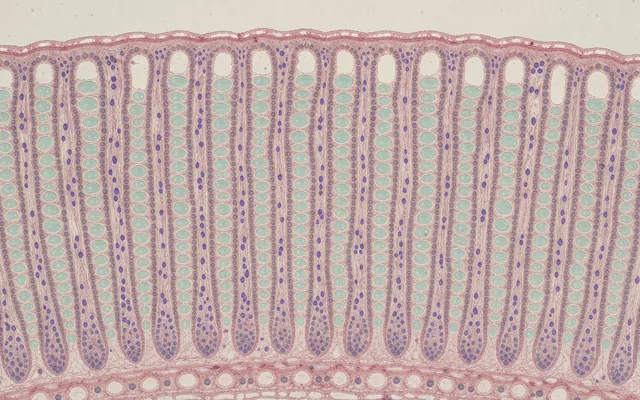
PepT1 is a transporter, a protein that moves small peptides into cells. The supplied mechanism describes increased PepT1 expression in inflamed intestinal tissue and uptake of KPV into epithelial cells, the cells of the intestinal lining. This gives the gut research a tissue-specific mechanistic anchor. [20]
Inside experimental cells, KPV reduces activity in NF-kB and MAP-kinase pathways. These are signaling systems involved in inflammatory responses. The studies report lower production of inflammatory cytokines, the chemical messages that cells use to coordinate inflammation. A change in signaling is an intermediate outcome; bowel healing or clinical remission requires additional evidence. [20][22]
Targeting a transporter does not prove that a preparation acts exclusively at an injury site. Distribution and tissue response still need measurement. The location-specific delivery experiments below are therefore more informative for this theme than a broad claim that KPV “calms inflammation everywhere.”
The findings belong to their formulations
Combination nanodrug. A study published in 2024 combined KPV with FK506, an immunosuppressant, in a PepT1-targeted nanodrug. In mice with acute and chronic chemically induced colitis, the combination improved disease outcomes, restored tight-junction proteins and reduced inflammatory cytokines more than either agent alone. Tight junctions help seal neighboring lining cells together. This is combination-treatment evidence in mice, not proof of free KPV's human effect. [18]
Targeted colon delivery. An earlier mouse study used hyaluronic-acid-functionalized nanoparticles carrying KPV within a chitosan/alginate hydrogel. In plain terms, modified small carriers were embedded in a gel to deliver the peptide to inflamed colon tissue. They reduced colitis severity and mucosal damage more effectively than non-targeted formulations. The carrier and gel are part of the experiment, not incidental packaging. [19]
Cell uptake and inflammatory signaling. Experiments in human intestinal epithelial cells and immune cells studied PepT1-mediated KPV uptake, reduced NF-kB and MAP-kinase activation, and lower inflammatory cytokine secretion. Mouse colitis experiments in the same supplied finding also showed reduced severity. The cell result and animal result should remain separately identified. [20]
Murine colitis and recovery. Another mouse study reported earlier recovery, improved regain of body weight, less inflammatory infiltrate and lower myeloperoxidase activity. Myeloperoxidase is an enzyme used as an indicator of inflammatory-cell activity. Effects persisted in mice lacking MC1R, a melanocortin receptor, supporting a mechanism not dependent on that receptor in the tested models. [21]
Broader review. The review distinguishes KPV's anti-inflammatory effects from the pigmentation effects of alpha-MSH. It discusses related tripeptides across several inflammatory and organ-injury models. That breadth is preclinical review context; it does not demonstrate a clinically effective KPV preparation or simultaneous repair of distant human organs. [22]
Reported effects: no anecdotal layer supplied
The KPV record supplied to this digest contains no community-effects series and no separate safety-caution series. No stories, frequency labels or adverse-event rates have been added to fill those empty categories. The absence of a report is not evidence of absence of harm.
The published findings summarized here do not establish human pharmacokinetics, meaning the peptide's absorption, distribution, breakdown and elimination in people. They also do not establish human efficacy, a clinical safety profile or a validated human-use regimen. Formulation work addresses an experimental delivery problem; it cannot be substituted for those missing clinical questions. [19][20][22]
The combination study requires particular restraint. Findings for KPV with an immunosuppressant belong to that combination. They cannot be read as safety or efficacy findings for an uncombined peptide, a different carrier, or a marketed preparation. [18]
The supplied regulatory summary records no FDA-approved drug or dietary-supplement status for KPV. It gives no established KPV-specific WADA classification and flags the uncertainty associated with non-approved substances. This entry provides no human-consumption instructions or determination of sporting eligibility.
Inflamed tissue is a location, not a universal reach
The strongest spatial thread is delivery to, and response within, the inflamed colon. Measured lining damage, inflammatory-cell activity and barrier proteins are relevant local endpoints. Tight-junction restoration concerns neighboring lining cells; it does not establish healing of an adjacent organ. Body-weight recovery is a broader animal outcome, not proof that distant tissue was repaired. [18][19][21]
The broader review offers other preclinical models, but each location retains its own experimental context. The comparison therefore positions KPV around intestinal inflammation and formulation-specific findings, with human and distant-organ repair claims left unestablished. An attractive delivery mechanism is a reason for further investigation, not a substitute for a clinical result. [20][22]